REN21

REN21, the Renewable Energy Policy Network for the 21st Century, is a policy network that provides a forum for international leadership in renewable energy policy, in order to share knowledge and facilitate the rapid growth of renewable energy technologies in developing countries and industrialised economies.
The network was launched in June 2005 as a result of discussion held the previous year at the International Conference for Renewable Energies in Bonn, Germany. Its secretariat operates from offices in Paris, France, and is provided by the United Nations Environment Programme and the Deutsche Gesellschaft für Technische Zusammenarbeit (German Technical Cooperation), in collaboration with the International Energy Agency. Like the Bonn Conference, REN21 distinguishes itself through its flexible nature and multi-stakeholder participation intended to provide a dynamic alternative to the official international fora. Its participants and members are drawn from a wide variety of bodies, including national and local governments, international associations and institutions, NGOs, the private sector, relevant partnerships and scientific panels, and other interested parties.
REN21 has produced a number of internationally recognised reports on renewable energy policy and the development of the renewables marketplace. Since 2005 REN21 has produced an annual Renewables Global Status Report, with Eric Martinot and Janet Sawin as lead authors.Presidential Forum on Renewable Energy
The Presidential Forum on Renewable Energy was created to ensure that renewable energy, sustainability, and conservation were top issues in the 2008 Presidential election. It brought together 2008 Presidential Candidates to generate discussion and foster innovation.
Presidential Candidate Forum
The Presidential Forum on Renewable Energy sponsored a presidential candidate forum on the afternoon of Saturday, November 17, 2007 at the Wadsworth Theater in Los Angeles. Hillary Clinton and John Edwards confirmed their participation, and we continue to work on lining up additional candidates to round out the event.
The Presidential Forum on Renewable Energy joined forces with leading environmental organizations to hold a single joint forum on global warming and renewable energy. Their partner organizations in hosting the event included the Natural Resources Defense Council, the League of Conservation Voters, and the Center for American Progress.
Nationwide Student Essay Contest
The Presidential Forum on Renewable Energy also sponsored a nationwide college student essay contest asking students to submit a Renewable Energy Plan for America. By engaging students, they encouraged them to incorporate an awareness of energy conservation into their everyday lives. A professional grading company along with board members of the Presidential Forum on Renewable Energy evaluated the essays and chose three first place winners. The Presidential Forum on Renewable Energy awarded a $10,000 educational prize to each of these three renewable energy scholars.
Office of Energy Efficiency and Renewable Energy

Management and Organization
The Office of Energy Efficiency and Renewable Energy's mission, according to the U.S. Department of Energy's Web site, is to strengthen America's energy security, environmental quality, and economic vitality in public-private partnerships that enhance energy efficiency and productivity; bring clean, reliable and affordable energy technologies to the marketplace; and make a difference in the everyday lives of Americans by enhancing their energy choices and their quality of life.
The Office of EERE is led by the Assistant Secretary of Energy Efficiency and Renewable Energy, who is appointed by the President and confirmed by the U.S. Senate. The Office manages ten major programs, each of which is responsible for research, development, and outreach in a particular field of renewable energy or energy efficiency.
Assistant Secretary
Cathy Zoi has been confirmed as USDOE's Assistant Secretary for Energy Efficiency and Renewable Energy (EERE).
Zoi is the founding chief executive officer of the Alliance for Climate Protection, which was established and chaired by former Vice President Al Gore. Zoi served as the Chief of Staff in the White House Office on Environmental Policy in the Clinton Administration, where she managed the team working on environmental and energy issues. She has also served as a manager at the U.S. Environmental Protection Agency (EPA), where she pioneered the Energy Star Program.
Zoi has also worked for several energy-focused organizations, serving as the group executive director at the Bayard Group, recently renamed Landis+Gyr Holdings, which is a world leader in energy measurement technologies and systems; as the assistant director general of the New South Wales EPA in Sydney, Australia; and as the founding chief executive officer of the New South Wales Sustainable Energy Development Authority (SEDA), a $50 million fund to commercialize greenhouse-friendly technology. Under her leadership, SEDA launched the world's first nationwide green power program and the world's largest solar-powered suburb.
Offices
EERE is divided internally into several different offices that are responsible for different aspects of its operations.
- Business Administration
- Commercialization and Deployment
- Golden Field Office
- Technology Advancement and Outreach
- Technology Development
Budget
The Office of EERE's annual budget is determined by annual congressional appropriations. The Office of EERE received $1,457,241,000 in fiscal year 2007, $1,722,407,000 in fiscal year 2008, and requested $1,255,393,000 for fiscal year 2009. These funds are divided among the ten EERE programs and internal costs such as program direction, program support, and facilities and infrastructure.
2007
These values are taken from the EERE 2007 budget documents.
| (values in thousands) | Appropriation | Request | Change | |||||
|---|---|---|---|---|---|---|---|---|
| 2006 | 2007 | 2008 | FY07 to FY08 | |||||
| Energy Supply and Conservation | ||||||||
| Biomass and Biorefinery Systems R&D | 89,776 | 149,687 | 179,263 | +29,576 | ||||
| Building Technologies | 68,190 | 77,329 | 86,456 | +9,127 | ||||
| Federal Energy Management Program | 18,974 | 16,906 | 16,791 | -115 | ||||
| Geothermal Technology | 22,762 | 0 | 0 | 0 | ||||
| Hydrogen Technology | 153,451 | 195,801 | 213,000 | +17,199 | ||||
| Hydropower | 495 | 0 | 0 | 0 | ||||
| Industrial Technologies | 55,856 | 45,563 | 45,998 | +435 | ||||
| Solar Energy | 81,791 | 148,372 | 148,304 | -68 | ||||
| Vehicle Technologies | 178,351 | 166,024 | 176,138 | +10,114 | ||||
| Weatherization and Intergovernmental Activities | 316,866 | 225,031 | 204,904 | -20,127 | ||||
| Wind Energy | 38,333 | 43,819 | 40,069 | -3,750 | ||||
| Facilities and Infrastructure | 26,052 | 5,935 | 6,982 | +1,047 | ||||
| Program Direction | 101,868 | 91,024 | 105,013 | +13,989 | ||||
| Program Support | 13,321 | 10,930 | 13,281 | +2,351 | ||||
| Adjustments | -3,339 | |||||||
| Total, Energy Supply and Conservation | 1,162,747 | 1,176,421 | 1,236,199 | +59,778 | ||||
Major Programs
Biomass
The Biomass Program works with industry, academia, and national laboratory partners on research in biomass feedstocks and conversion technologies. Key goals of the Program include focusing research and development efforts to ensure that cellulosic ethanol is cost competitive by 2012, and further developing infrastructure and opportunities for market penetration of bio-based fuels and products.
Building Technologies
The Building Technologies Program works to improve the energy efficiency of new and existing buildings through industry partnerships, research, and tool development. The program’s strategic goal is to create technologies and design approaches that lead to marketable net zero energy homes by 2020 and net zero energy commercial buildings by 2025.
The Building Technologies Program oversees the U.S. Department of Energy's work with ENERGY STAR, which is managed through partnership with the United States Environmental Protection Agency.
Federal Energy Management
The Federal Energy Management Program facilitates the federal government's implementation of cost-effective energy management and investment practices. This is delivered through project transaction services, applied technology services, and decision support services.
Geothermal Technologies
The Geothermal Technologies Program supports research and development for geothermal energy technologies, and supports finding, accessing, and using geothermal resources in the United States. One of their primary goals is to develop a 5 megawatt proof-of-principle demonstration of enhanced geothermal systems technology by 2015, and to validate the sustainability of this project by 2020.
Hydrogen, Fuel Cells and Infrastructure Technologies
The Hydrogen, Fuel Cells and Infrastructure Technologies Program works with academia, industry, the U.S. Department of Energy's national laboratories, and EERE's Vehicle Technologies Program to research and develop hydrogen production, delivery, and storage technologies; to develop hydrogen safety codes and standards; to validate and demonstrate hydrogen technologies in real-world situations; and to educate stakeholders about these technologies.
Industrial Technologies
The Industrial Technologies Program works with U.S. industries to reduce their energy intensity and carbon emissions, and supports the development of advanced industrial technologies and energy management best practices. Through the Save Energy Now initiative, this program is leading a drive to reduce industrial energy intensity 25% by 2017, a national goal outlined in the Energy Policy Act of 2005.
Solar Energy Technologies
The Solar Energy Technologies Program focuses on accelerating the advancement of solar energy technologies. Its four subprograms are photovoltaics, concentrating solar power, market transformation, and systems integration.
Vehicle Technologies
The Vehicle Technologies Program works with industry to develop technologies that could increase vehicle energy efficiency and to research, develop, demonstrate, test, validate, commercialize, and educate about alternative fuel vehicles.
Weatherization & Intergovernmental
The Weatherization and Intergovernmental Program provides grants to state governments, Indian tribes, municipal utilities, and low-income families through four separate programs that utilize all of EERE’s energy efficiency and renewable energy technologies:
- Renewable Energy Production Incentive
- State Energy Program
- Tribal Energy Program
- Weatherization Assistance Program
Wind and Hydropower Technologies
The Wind and Hydropower Technologies Program conducts research in wind and water energy technologies. Wind energy R&D includes utility-scale technologies for both land-based and offshore applications and small distributed wind energy systems for home, farm, and business applications. One example of a project sponsored by the Wind and Hydropower Technologies Program is the Wind ENergy Data & Information (WENDI) Gateway, established by Oak Ridge National Laboratory in March 2010. Water energy research includes traditional hydropower technologies as well as wave energy, ocean current, tidal current, and river current technologies.
EERE-Funded Activities and Events
The Office of EERE sponsors, in whole or in part, activities aimed at public outreach and engagement in energy efficiency and renewable energy technologies. Prominent national events include:
Solar Decathlon
The Solar Decathlon is a competition held in Washington, D.C. every other year. Students from 20 universities and colleges across the United States and the world construct homes that are powered exclusively by solar energy. These homes are displayed on the National Mall in Washington, D.C. and judged in ten contests.
The next Solar Decathlon will be held in 2009, on October 9-13 and 15-18.
EcoCAR: The NeXt Challenge
EcoCAR is a college-level competition during which college-level students at 17 North American universities are given three years to produce a zero emissions vehicle. The students produce a variety of alternative vehicles, including full-function electric, range-extended electric, hybrid, plug-in hybrid, and fuel cell vehicles. The event culminates in a week-long competition.
The event is run by the U.S. Department of Energy and General Motors.
Solar America Cities
Solar America Cities is a partnership between the U.S. Department of Energy, 25 cities across the United States, and municipal, county, and state agencies, universities, solar companies, utilities, developers, and non-profit organizations. The 25 selected cities each received $5 million, as well as technical assistance from the U.S. Department of Energy, to:
- Integrate solar energy technologies into city energy planning
- Remove barriers to solar energy development in their city
- Promote solar technologies among the residents and local businesses.
International Renewable Energy Agency

The International Renewable Energy Agency (IRENA) was founded in 2009 to promote widespread and increased adoption and sustainable use of all forms or renewable energy.
Acting as the global voice for renewable energies, IRENA will facilitate access to all relevant renewable energy information, including technical data. By september 2010, 149 countries and the European Union had signed the agency’s statute, including countries in 48 African, 38 European, 35 Asian, 17 American and 10 Australia/Oceania States. 33 countries and the European Union have ratified its treaty. The statute entered into force on 8 July 2010.
On June 2009, at Sharm el-Sheikh, Egypt, the French citizen Hélène Pelosse was elected Interim Director-General, a position she resigned on October 21, 2010. Abu Dhabi in the United Arab Emirates was elected as interim headquarters of the Agency.
IRENA's founding reflects a growing consensus among governments around the world on the need to speed up the commercialization of renewable energy worldwide. IRENA provides advice and support to governments on renewable energy policy, capacity building, and technology transfer. IRENA will also co-ordinate with existing renewable energy organizations, such as REN21.Aims
Mandated by governments worldwide, IRENA aims to become the main driving force in promoting a rapid transition towards the widespread and sustainable use of renewable energy on a global scale:
Acting as the global voice for renewable energies, IRENA will provide practical advice and support for both industrialised and developing countries, help them improve their regulatory frameworks and build capacity. The agency will facilitate access to all relevant information including reliable data on the potential of renewable energy, best practices, effective financial mechanisms and state-of-the-art technological expertise.
Actions
Right after the Interim Director general elections, IRENA started its actions with the Kingdom of Tonga. These South Pacific islands are currently almost totally reliant on imported diesel for electricity. In 2009, 19% of Tonga’s GDP and 25% of its imports consisted of diesel purchases. With the assistance of IRENA, Tonga has developed the 2010-2020 Tonga Energy Road Map (TERM), which aims for a 50% reduction of diesel importation. This will be accomplished through a range of appropriate renewable technologies, including wind and solar, as well as innovative efficiencies.
Member States
As of July 21, 2010, 148 countries and the European Union have joined IRENA. Among them, almost all European and 48 African States. The United States officially joined the International Renewable Energy Agency (IRENA), increasing the number of countries participating in the organization to 136. The U.S. participation is an important element of the Obama Administration's effort to support renewable energy technologies and economy needed to address climate change. U.S. Secretary of State Hillary Rodham Clinton said that the United States will work closely with other signatories, IRENA's leadership, and members of Congress to ensure that the new agency's work augments and complements other renewable energy efforts. U.S. Ambassador Reno Harnish signed the IRENA statute at the second session of the IRENA Preparatory Commission in Egypt. Other major countries joined also. Like India, Japan, Australia.
United Nations
| “ | Various UN organisations work in the field of renewable energy. But IRENA is the only one dedicated to the promotion of 100% renewable energy worldwide. IRENA and the UN will join forces to speed up the transformation of the global energy sector | ” |
| —Hélène Pelosse | ||
Hélène Pelosse, Director General of IRENA, met with UN Secretary General Ban Ki-moon during 2009 Climate week in New York, together with Mr. Ban explored future fields of cooperation between IRENA and various UN bodies. IRENA seeks to cooperate with the UN and associated organisations in the areas of education and training, financing, access to energy, potential studies and trade. IRENA will team up with organisations like the United Nations University, UNESCO, the World Bank and GEF, UNIDO, UNDP, UNEP and the WTO.
International Renewable Energy Alliance
International Renewable Energy Agency

The International Renewable Energy Agency (IRENA) was founded in 2009 to promote widespread and increased adoption and sustainable use of all forms or renewable energy.
Acting as the global voice for renewable energies, IRENA will facilitate access to all relevant renewable energy information, including technical data. By september 2010, 149 countries and the European Union had signed the agency’s statute, including countries in 48 African, 38 European, 35 Asian, 17 American and 10 Australia/Oceania States. 33 countries and the European Union have ratified its treaty. The statute entered into force on 8 July 2010.
On June 2009, at Sharm el-Sheikh, Egypt, the French citizen Hélène Pelosse was elected Interim Director-General. Abu Dhabi in the United Arab Emirates was elected as interim headquarters of the Agency.
IRENA's founding reflects a growing consensus among governments around the world on the need to speed up the commercialization of renewable energy worldwide. IRENA provides advice and support to governments on renewable energy policy, capacity building, and technology transfer. IRENA will also co-ordinate with existing renewable energy organizations, such as REN21.International Network for Sustainable Energy

International Network for Sustainable Energy (INFORSE) was established in 1992 at the Global Forum, which was a parallel forum to the UNCED Conference so called Earth Summit. In 1998, INFORSE got consultative status to United Nation's ECOSOC. INFORSE is working through Regional Coordinators in Asia, Africa, Europe, Americas. The INFORSE Secretariat is in Denmark. In 2002, INFORSE-Europe was registered in Denmark as an NGO network working on European level.
INFORSE Activities
- Develops scenarios for a transition to a 100% renewables energy supply with factor four energy efficiency by 2050. A global, EU-27 and European national scenarios are developed. The name of the sustainable energy model is INFORSE Vision 2050.
- World-wide database of about 1000 contacts, web based resources on EU policy, school materials, successes
- Online course material (DIERET)
- Quarterly newsletter: Sustainable Energy News (SEN) published since 1992
- Participation on UN Conferences as NGO observer as INFORSE has Consultative Status at UN ECOSOC and UNFCCC. Participation at e.g.,:
- UN Commission on Sustainable Development (CSD) (CSD9, CSD14 and CSD15 in New York)
- UNFCCC (e.g., Exhibition and side event at COP 14, Poznan, 2008; and COP 15 Copenhagen
- Beijing International Renewable Energy Conference (BIREC 2005), Beijing, China
- Renewables'04, Bonn International Renewable Energy Conference, Bonn 2004
- WSSD, World Summit on Sustainable Development (Earth Summit 2002) in Johannesburg in 2002.
- Participation on EU Consultations, Press Releases.
- Organising European NGO Policy Seminars.
- Exhibition, participation at EU events, e.g., EU Green Week, Sustainable Energy Week. See more at INFORSE-Europe.
 | |
| Founders | NGOs |
|---|---|
| Type | Network of NGOs, grassroot organisations |
| Founded | 1992 |
| Location | Denmark |
| Key people | Regional coordinators |
| Area served | World wide |
| Focus | sustainable energy environmentalism |
| Method | newsletter, education, research, lobbying |
| Members | 160 NGOs worldwide |
INFORSE Europe

INFORSE- Europe is an international, non-profit organisation (NGO) network of European environmental organizations promoting sustainable energy development within Europe; and worldwide in cooperation with other INFORSE regions.
INFORSE-Europe Activities
- Develops scenarios for a transition to a 100% renewable energy supply by 2050. A global, EU-27 and national models are developed for Denmark, Latvia, Lithuania, Ukraine, Slovakia, Belarus, and Romania. The model's name is INFORSE Vision 2050.
- Maintains the European section of the INFORSE's worldwide database of contacts, Web-based resources on EU policy, school materials on energy and climate, successes
- Online course (DIERET)
- Cooperation with SPARE, a sustainable energy education project in 16 countries.
- Quarterly newsletter: Sustainable Energy News (SEN)
- Participation on UN Commission on Sustainable Development (CSD) and UNFCCC as an INFORSE observer and side event organiser, as INFORSE has consultative NGO status to ECOSOC.
- Participation on EU Consultations, Press Releases.
- Organising European NGO Policy Seminars.
- In 2007-08, INFORSE-Europe is making EU Ecodesign Standardisation Positions together with ECOS, the European Environmental Bureau, Climate Action Network-Europe, Greenpeace and the World Wide Fund for Nature.
- Exhibition at EU Green Week'05 and '09, and EU Sustainable Energy Week (EUSEW) 2008
 | |
| Founders | European NGOs |
|---|---|
| Type | Network of European NGOs, grassroot organisations |
| Founded | 1994, (Bylaws) 2002 (Registration) |
| Location | Denmark |
| Key people | Gunnar Boye Olesen, Emil Bedi (coordinators) |
| Area served | Europe |
| Focus | sustainable energy environmentalism |
| Method | newsletter, education, research, lobbying |
| Members | 70 NGOs from 30 European countries |
Green Power Forum
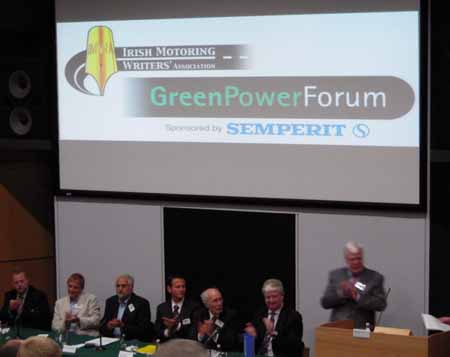
The Green Power Forum hosts conferences aiming to advise on the financial benefits of renewable technologies, government legislation, products, and technologies. Delegates attend from sectors including construction, facilities managers, energy managers, engineers and architects. The first conference was held in Liverpool in October 2009.
The chairman of GPF is Mark McManus, the managing director of heat pump specialist Stiebel Eltron UK. Other members of the Green Power Board include North West Energy Support Agency, Envirolink Northwest, underfloor heating supplier Nu-Heat, sustainable energy consultants and installers ISO Energy UK and Liverpool Chamber of Commerce.European Renewable Energy Council

The European Renewable Energy Council (EREC) was founded in 2000 by the European renewable energy industry, trade and research associations. EREC is located in the Renewable Energy House in Brussels, a monument protected building with 100% renewable energy supply for heating and cooling.
EREC acts as a representative in Brussels of the European Renewable industry and research community and acts as a forum for exchange of information and discussion on issues related to renewables. EREC provides information and consultancy on renewable energies for the political decision makers on local, regional, national and international levels.
EREC is composed of the following non-profit associations and federations:
- AEBIOM (European Biomass Association)
- EGEC (European Geothermal Energy Council)
- EPIA (European Photovoltaic Industry Association)
- EREF (European Renewable Energies Federation).
- ESHA (European Small Hydropower Association)
- ESTIF (European Solar Thermal Industry Federation)
- EUBIA (European Biomass Industry Association)
- EUREC Agency (European Renewable Energy Research Centres Agency)
- EWEA (European Wind Energy Association)
International Projects
EREC is involved in a number of international projects to promote renewable energy sources within the European Union and worldwide:
Ongoing projects are:
Smart-e buildings-yes we can enable the building sector to contribute to reaching the 3x20 objectives (Smart-e buildings)
- Common quality certification & accreditation for installers of small-scale renewable energy systems
- Renewable Energy Policy Action Paving the Way towards 2020
- Thematic Network on ICT solutions to enable Smart Distributed Generation
- New Energy for Old Buildings- Promoting RES and RUE Integration in Hictoric buildings (New4Old)
- INOGATE Technical Secretariat and INOGATE Coordinator's Network (INOGATE)
- Market Access for Smaller Size Intelligent Electricity Generation (MASSIG)
- Addressing regulations on STORage technologies for increasing the penetration of Intermittent Energy Sources (STORIES)
- Energy Union Tour (Energy Union)
- Excellence in Energy for the Tourism Industry (EETI)
Finalised projects are:
- Optimisation of Support Schemes for Renewable Energy Sources for Electricity Generation, Heating and Cooling (SUPPORT_ERS)
- Monitoring & valuating RES Directives, implementation in EU-27 and policy recommendations (RES2020)
- RES and RUE Stimulation in Mountainous-Agricultural Communities towards Sustainable Development (MOUNTAIN-RES)
- Creating Markets for Renewable Energy Technologies - EU RES Technology Marketing Campaigns (RESTMAC)
- Energy4Cohesion
- EurObserv'ER Barometer
- Key issues for Renewable Heat in Europe (K4RES-H)
- Eco Heat and Cooling (ECOHEATCOOL)
- European RE-Islands
- Sustainable Communities
- Campaign for Take-Off Impact Assessment
- European Renewable Energy Export Strategy (EUREES)
- RES Information Dissemination Campaign for Europe (RES Info Europe)
- Promotion and Market Stimulation of RES in EU and Candidate Countries (RES in EU and CC)
- Towards a White Paper for RES and RUE Strategy and Action Plan for the Republic of Cyprus
- Green X - Deriving Optimal Promotion Strategies for Increasing the Share of RES-Electricity
- Energy Technology Centre - Russia
- Building up commercial structures for RES in China
- OPET RES-e: New EU technology network for green electricity technology
- Euro-Caribbean Island Cooperation in Sustainable Energies (Euro-Caribbean RES forum)
Environmental and Energy Study Institute

The Environmental and Energy Study Institute (EESI) is a non-profit organization based in Washington DC which promotes environmentally sustainable societies. Founded by a bipartisan and bicameral group of Congressional Members, EESI seeks to be a catalyst that moves society away from environmentally damaging fossil fuels and toward a clean energy future. EESI advances policy solutions that will result in decreased global warming and air pollution; improvements in public health, energy security and rural economic development opportunities; increased use of renewable energy sources and improved energy efficiency; and the protection of areas such as the Arctic and coastal regions.
EESI educates policymakers and the public through timely information and innovative policy initiatives in the form of Congressional briefings, publications, task forces and meetings. EESI’s current programs are: Energy & Climate; Sustainable Biomass & Energy, which covers bioenergy, biofuels and biobased products from agriculture and forestry; and Transportation & Smart Growth. The Executive Director is Carol Werner.
EESI grew out of the Environmental Study Conference, which was an informal Congressional study group that began in 1975 with a bi-partisan group of House Members, led by former Congressman Richard Ottinger, former Congressman John Heinz, and former Congressman Gilbert Gude. Over the years, the Study Conference grew, expanded to the Senate and added the word “energy” to its name. The membership of the Conference grew to more than 85 Senators and 295 Representatives. Because the Conference was unable to support its work entirely on Congressional funds and rules prohibited their receipt of outside financial support, in 1982 they formed the Environmental and Energy Study Institute (EESI). EESI was formed as a totally separate and distinct entity, controlled by a private board of directors, which included several Members of Congress. EESI incorporated and received its IRS 501(c)(3) status in 1984.
Energy-Quest

Energy-Quest (formerly The Hydrogen Expedition) was an organization that sought to educate the public about the risks of an impending energy crisis due to the current worldwide dependence on fossil fuels and the benefits of energy conservation and the use of renewable energy sources. It intended to do so through a series of three record-setting ocean voyages:
- The Earthrace
- The Aurora Expedition
- The Triton Expedition
Started and staffed by university students, the project was endorsed by several organizations and prominent individuals.
The Earthrace
The Earthrace will be an attempt to break the speed record for circumnavigating the globe in a powerboat while using only renewable fuels. It is being supported by over 100 companies, and is led by New Zealander Pete Bethune. Energy-Quest is providing organizational and fundraising assistance to the Earthrace in the United States.
The Aurora Expedition
The Aurora Expedition will involve an around-the-world voyage in a powerboat which, at 20 ft, will be the smallest vessel of its kind to ever complete such a journey. Due to its limited fuel capacity, the Aurora will rely on advanced fuel-efficient technologies for propulsion. Energy-Quest thus seeks to incorporate highly clean and efficient diesel engines, solar cells, and wind turbines into this design.
Aurora will stop at over forty major ports around the world, where she will showcase the cleanest and most efficient energy technologies available at the time, and her crew will promote the widespread use of such technologies. Ultimately, the Aurora Expedition is intended as a stepping stone towards the completion of the organization's final and most important endeavor – the Triton Expedition.
The Triton Expedition
The Triton Expedition will be the first circumnavigation of the world by a boat powered solely by a hydrogen fuel cell. Triton will stop at major destinations around the world, where her crew will meet with local political and industrial leaders to promote the importance of alternative energy development. Through Triton's voyage, Energy-Quest hopes to generate international media attention, and in this way stimulate the development of a renewable energy-based hydrogen economy.
History
The project was started in the summer of 2005 by Joseph F. Sahid, a graduate of the Phillips Exeter Academy and currently a sophomore at the University of Pennsylvania. He soon was joined by other volunteers, and an official team was rapidly assembled. The Energy Quest program has been now been discontinued.
Danish Organisation for Renewable Energy

Aim
OVE’s aim is to work for a resource- and environment-conscious energy policy through grassroots initiatives to reach 100 % renewable energy supply in Denmark by 2030.
Objectives
OVE has a strong engagement:
- to influence the development of the Danish energy policy to be more resource- and environment-conscious especially by facilitating the use of renewable energy.
- to get the people informed of their possibilities to make their own action by installing renewable-energy systems in their own homes or institutions in Denmark.
Structure
Members: - Danish individuals who are users of renewable energy, as well as of groups, high schools, and companies working for renewable energy in Denmark. A special category of the members are the local Energy and Environment Offices, local popular information centers. In total, OVE has about 2500 members.
Decisions: - OVE's main decisions are made at the yearly General Assembly of the members and the bimonthly Board Meetings. The Members of the Board is elected at the General Assembly. The Chairman is elected by the Board.
Information: - The members are informed through a bimonthly magazine, in several subject-specific meetings, and a web site.
Activities in Denmark
Political Lobbying
- Seeking to be represented in the energy related law and regulation formulating processes through hearings and committees.
- Evaluating and producing policy and campaign papers on renewable energy issues.
Information Dissemination
- Publishing a Danish bi-monthly magazine "Renewable Energy and Environment" (In Danish: Vedvarende Energi & Miljø for the members.
- Offering a homepage with keys to literature, demonstration plants, companies and other relevant sites on the internet in Danish.
- Promoting information campaigns and giving advice in a close co-operation with the offices of “Energy Services” and “Local Energy and Environmental Offices (SEK)” e.g., the "Campaign for converting houses from electric heating systems into more environmental friendly energy sources like renewable energy" or Energy efficient windows”.
- Involved in the Schools Energy Forum (SEF) aiming to implement more and better education on energy and environmental matters. Through SEF, OVE is partner to the Climate Caravan, which is offering educational possibilities in the schools in 98 municipalities of Denmark.
- Organising seminars, meetings at which technicians and users share knowledge and experiences. The main topics discussed are wind power, solar energy, biogas, energy efficiency, and renewable energy in green cities, along with integration of renewable energy into energy systems such as those for local cogeneration of heat and power.
Cooperation in Denmark
OVE has gone into co-operation with many other organisations interested in energy in Denmark. Among others:
- OVE’s bi-monthly magazine is published in cooperation with National Association for Organic Building and the Association of Energy Offices (SEK).
- OVE is one of the 20 members of the Danish 92-Group (In Danish: 92-gruppen) where Danish environment and development organisations are cooperating since the UNCED Conference preparations in 1992. E.g., OVE was made a Climate Campaign in 2002 in cooperation with Greenpeace-Danmark, WWF-Denmark, Nature and Youth (in Danish: Natur og Ungdom), The Ecological Council (in Danish: Økologisk Råd), and FEU.
Cooperation internationally
- OVE is active in projects in Europe, Asia and Africa to defend environment and decrease poverty. OVE has or has had projects in Thailand, Vietnam, Mozambique, Mongolia and in South Africa in co-operation with local NGOs.
OVE plays a significant role in international networking among NGOs. OVE is member of:
- INFORSE-Europe, International Network for Sustainable Energy, a NGO network with its International Secretariat based in Denmark, and with 7 Regional Co-ordinators in different continents. OVE is one of the founders of INFORSE in 1992.
- CAN-Europe, Climate Action Network - Europe, a NGO Network with a Secretariat based in Brussels, Belgium. [11]
- European ECO-forum Pan-European network of NGOs on environment
The list of Renewable Energy Associations
- Renewable energy - Danish Organisation for Renewable Energy (OVE)
- Renewable energy - Energy-Quest
- Renewable energy - Environmental and Energy Study Institute
- Renewable energy - European Renewable Energy Council
- Renewable energy - Green Power Forum
- Renewable energy - INFORSE-Europe
- Renewable energy - International Network for Sustainable Energy (INFORSE)
- Renewable energy - International Renewable Energy Agency
- Renewable energy - International Renewable Energy Alliance (REN Alliance)
- Renewable energy - International Sustainable Energy Agency
- Renewable energy - Office of Energy Efficiency and Renewable Energy
- Renewable energy - Presidential Forum on Renewable Energy
- Renewable energy - REN21
- Renewable energy - Renewable and Appropriate Energy Laboratory
- Renewable energy - Renewable Energy and Energy Efficiency Partnership
- Renewable energy - Renewable Fuels Association
- Renewable energy - Rocky Mountain Institute
- Renewable energy - Trans-Mediterranean Renewable Energy Cooperation
- Renewable energy - World Council for Renewable Energy
- Geothermal energy - Geothermal Energy Association
- Biomass - Biomass Thermal Energy Council (BTEC)
- Hydropower - International Hydropower Association (IHA) (International)
- Hydropower - National Hydropower Association (US)
- Solar energy - International Solar Energy Society
- Solar energy - Solar Cookers International
- Solar energy - Solar Energy Industries Association (SEIA)
- Wind energy - American Wind Energy Association
- Wind energy - British Wind Energy Association
- Wind energy - European Wind Energy Association
- Wind energy - Global Wind Energy Council
- Wind energy - World Wind Energy Association